
What is meditation, and how do you do it?
Meditation is deeply relaxing the body and then keeping the mind completely "blank," with no thoughts at all. A simple mantra, repeated silently, helps you let each thought go. Practiced regularly, it calms you, opens your mind to new ideas and helps you reach your Higher Self.
How is meditation different from concentration?
Meditation is often confused with concentration. Concentration exercises focus your full attention on one part of how your mind or body works, to reach a goal or build a skill. Yoga, tai chi, breathing exercises and visualization are all forms of concentration.
Meditation, on the other hand, aims to stop thoughts in a natural way. You deeply relax the physical body and then try to keep the mind completely "blank," with no thoughts whatsoever. You might hold that state for a few seconds or a few hours, depending on your skill.
Why does meditation help you reach your Higher Self?
A pure mind is essential to reach the Higher Self. It seems the Higher Self does not admit any impurities.
To reach it, it's best to concentrate on the source of the "inner sound," which leads to the "inner light," the heart of the Higher Self. At first it seems infinitely far away, "at the other side of a long dark tunnel." When you get close enough, the inner light becomes much brighter than the Sun, and when you are allowed to join it, the bliss can't be described in any human language. To get that far, you need complete purity of mind during meditation and pure intentions, and then you concentrate intensely for a while on the inner sound and the inner light.
The most important role of a spiritual teacher is to show each person their own way to the Higher Self. Then it is up to you to practice and reach it.
What is a mantra for?
There are many meditation techniques, and most use a mantra: a few words or sounds you repeat silently to help you reach and keep a blank state of mind.
Contrary to what some people who attract followers or charge money to teach meditation say, a mantra has no sacred "meaning," and no mantra is better than another. Whatever its content, a mantra does two important jobs:
- It replaces other thoughts. A mantra is a very simple thought that becomes very familiar as you repeat it. Every time a thought comes during meditation, you use the mantra to replace it.
- It becomes an anchor for calm. When you meditate regularly with the same mantra, your mind learns to link it with a calm, meditative state. Neuro-Linguistic Programming (NLP) practitioners call this an "anchor." After that, even when you're upset, thinking of your mantra usually brings immediate calm. That makes it a powerful tool for stressful times, one you build yourself through regular practice.
Once you understand these two jobs, it's clear that changing mantras usually isn't a good idea. It may help only in special cases, for example when you want to break a meditation habit that keeps you from going deep, and your current mantra is tied to that habit.
It also makes sense to keep your mantra private. Otherwise you give others a way to influence your subconscious mind by sending your own mantra to you telepathically. The best teachers take the time to give each person their own mantra rather than teaching everyone the same one.
What makes a good mantra?
Mantras are usually made of alternating vowel and nasal sounds and may have several words. The best known is "ooohmmm" or "aaaaummm," but any similar word works when you stretch out the vowel and nasal sounds (home, room, zoom, moon, zen, boom and so on). It's best if your mantra is an unusual word or series of syllables you don't hear in everyday conversation.
What is the best posture for meditation?
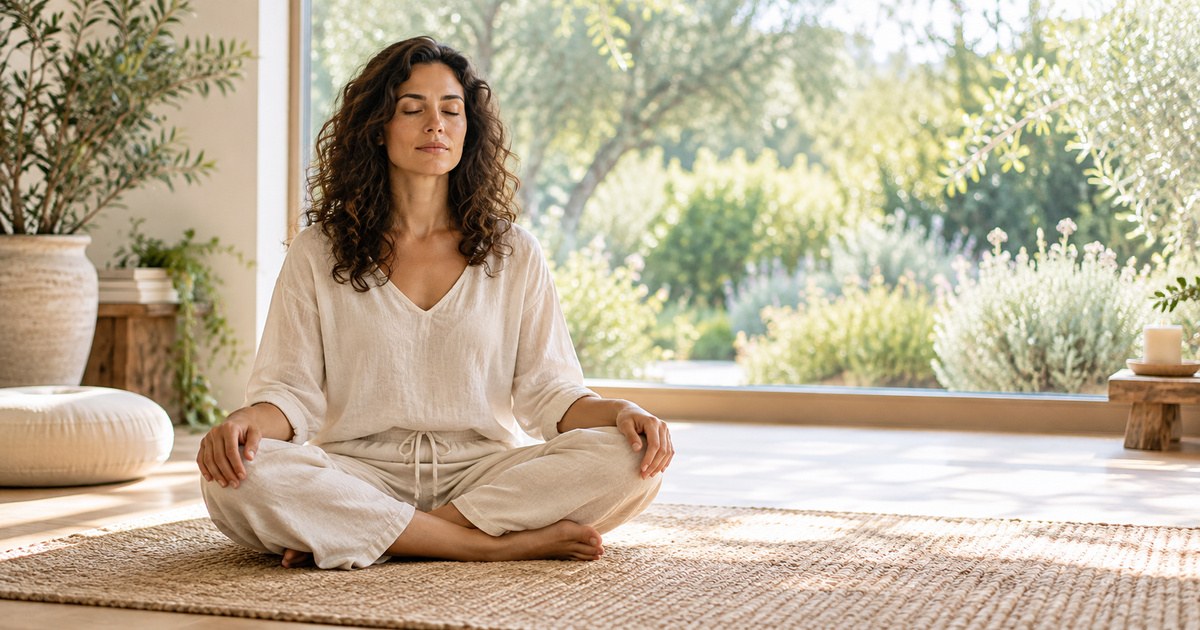
Posture matters too. The easiest is a comfortable sitting position with your spine straight. If you lie down, you will most likely fall asleep. Joining your hands and crossing your legs helps, because it makes the energy field around you more compact and intense. Sitting cross-legged is another good position, but it takes some fitness and practice. Another good one, though rarely used today, is squatting with your arms crossed over your knees, like a baby in the womb.
How do you start meditating?
If you have never meditated, find a quiet place and try this:
- Sit in a comfortable meditation posture, one of those described above.
- Close your eyes and relax every muscle in your body, including your face. A few alternate-nostril breaths help at the start: breathe in through one nostril and out through the other, closing one nostril with a finger and switching with each breath.
- Let go of each thought as it comes, without following it into a chain of thoughts. Keep your mind blank for about 20 minutes. You can use the mental sound "ooooohhmmm" (a mantra) every time a thought comes. Or you can count your thoughts, letting each one go without analyzing it. When you are down to two or three thoughts in five minutes, you are meditating successfully.
With practice, you should be able to reach a blank mind anytime and anywhere, even in a crowd or a stressful situation, with the help of your mantra. But don't use the mantra when you're stressed until you've practiced long enough that it is firmly linked to your calm state of mind.
What are the benefits of meditation?
One of the many benefits is that meditation opens your mind to new ideas. When a bowl is full, pouring in more water just makes it overflow. The mind is the same: when it's full of thoughts, there's no room for new ideas.
Meditation is very effective for improving creativity and problem solving. "Talented" people do it naturally, and artists and poets call it "inspiration."
Meditation is sometimes described as "listening to the silence between thoughts." In meditation, we consciously try to lengthen those silences.
The ability to meditate is also needed to receive telepathic messages, including those from the Higher Self and from others who may be trying to help us. Without true silence in your own thoughts, you can't hear the thoughts of others.
Before meditating, you might decide clearly what you want to learn or ask your Higher Self. During meditation, don't expect an answer (although one may well come when your mind is pure), because expecting is also a thought!
People who meditate regularly often look and feel younger than others their age. Giving the mind a regular "break" and letting nature do its repair work every day makes a real difference.
© Dr. Tom J. Chalko 1997